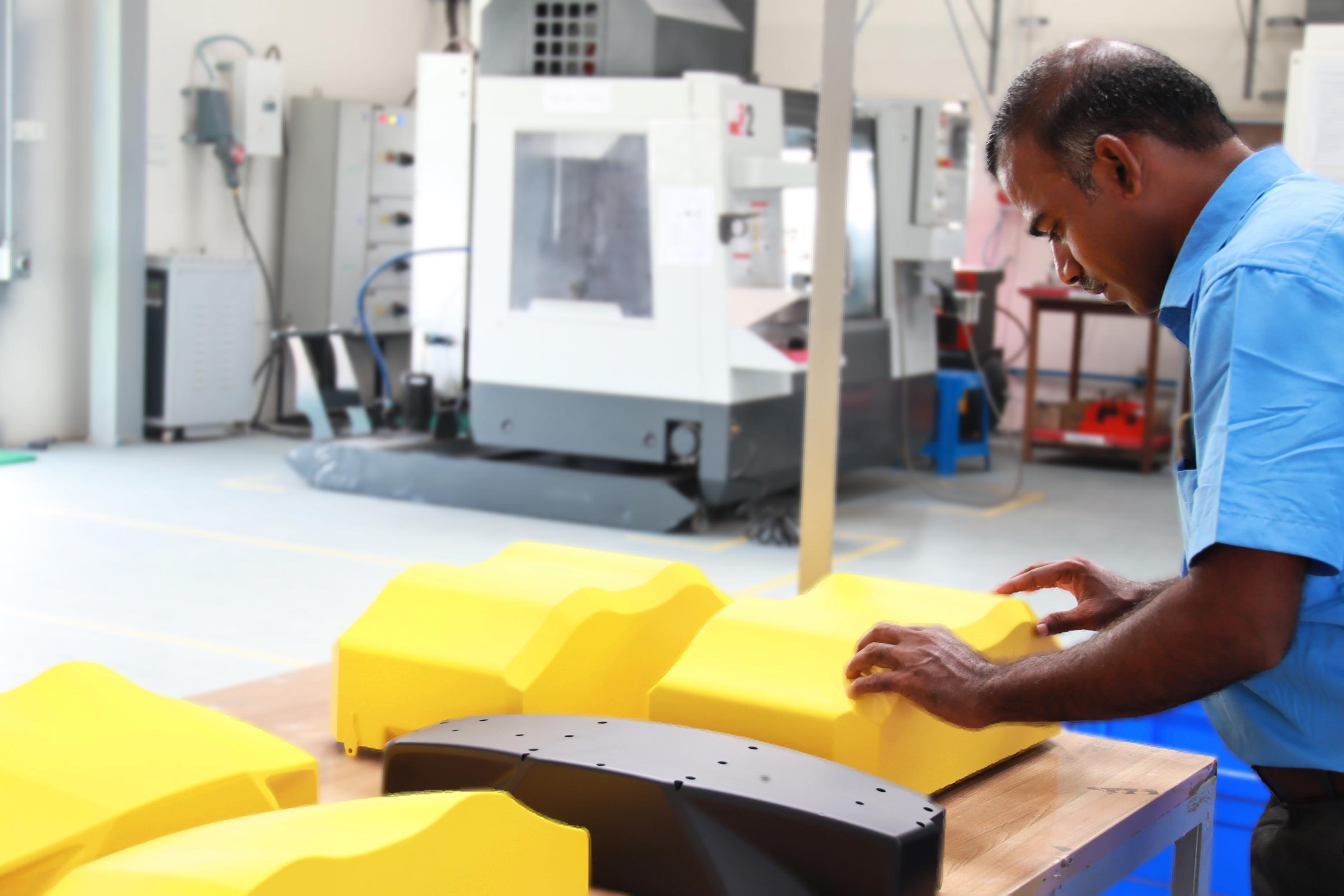
3D Printing Services in Chennai: The Complete Buyer Guide
If you are searching for 3d printing chennai, you are probably not looking for a lecture on how additive manufacturing works. You are looking for answers you can act on.
How fast can I get parts
What will it cost
Which process and material should I choose
Who can deliver consistent quality and repeatability
Can this scale from one prototype to production
This buyer guide is written for founders, product teams, manufacturing teams, R and D engineers, and even students who want to build real parts, test ideas faster, and move from concept to production without wasting weeks.
You will learn what you can make with 3d printing in chennai, which methods are commonly used, which materials suit which use cases, what lead times look like, how pricing is usually calculated, and how to pick the right partner for reliability. You will also see where Injection Moulding fits when your part is ready for scale.
At Amuse3D, we build parts every day for automotive, drones, industrial equipment, and more. We deliver millions of parts to customers across the world each year, with strong quality systems and a fast turnaround mindset. This guide shares the exact decision framework we use with buyers so you can make smarter choices.
What you can make with 3D printing in Chennai
3D printing is not just for demos. It is used today for functional prototypes, production grade components, and tooling that improves factory output. Here are the most common part categories people buy from 3d printing services in chennai.
Functional prototypes you can test
Prototypes are the fastest way to validate size, fit, assembly, and basic function. Instead of waiting for traditional tooling, teams can iterate in days. This is useful when your product is still evolving and you want to test multiple design directions without high upfront cost.
Typical examples include
Product housings and covers
Snap fit parts
Mounting brackets
Clips, clamps, and retainers
Ergonomic grips and handles
Prototype assemblies for fit checks
Jigs, fixtures, and production aids
A huge practical use of 3D printing technology is building tools that help operators work faster and more consistently. These parts do not need to look pretty. They need to be strong, accurate, and repeatable.
Common examples include
Assembly jigs for alignment
Drill guides
Inspection fixtures
Holding and clamping tools
Pick and place aids
Tooling inserts for small batch runs
Enclosures for electronics and industrial equipment
Startups and product teams often need a clean enclosure that can hold electronics securely and survive real usage. With the right material and process, you can get strong enclosures that look professional and are ready for field testing.
Examples include
Sensor housings
Cable management clips
Control boxes and handheld enclosures
Protective covers for equipment
Prototype pods for outdoor testing
Low volume end use parts
If you need tens, hundreds, or sometimes thousands of parts, 3D printing can often deliver faster than traditional routes. This is popular when you want to test market demand, run pilot projects, or ship early versions without locking into a tool.
Industry specific applications
Different industries use 3D printing differently. In Chennai, demand is strong across automotive, drones, industrial manufacturing, and healthcare. You will see buyers ask specifically for
3D Printing Automotive parts like brackets, clips, ducting, clamps, mounts, covers, and functional test components. These help teams improve packaging, reduce weight, and iterate faster.
Medical 3D Printing for prototypes, ergonomic testing, device housings, and fixtures. Many medical projects need tight control on fit, finish, and repeatability.
3D Printing Drone parts for lightweight frames, mounts, covers, payload holders, antenna mounts, and aerodynamic housings. Strength to weight matters here, along with quick iteration.
3D Printing Aerospace & Defense for prototype components, tooling, fixtures, and specialized housings where precision and documentation matter.
If your requirement goes beyond polymer parts, you might also evaluate CNC Machining Services for metal components or very tight tolerance features. Many buyers use a mix of processes based on the function of each part in the assembly.
Which 3D printing methods are available
When people search for 3d printers in chennai, they often assume all 3D printing is the same. In reality, the printing method changes strength, surface finish, accuracy, cost, and lead time.
Here are the most common methods you will come across. The key is to pick the method that matches your use case, not the one that sounds fancy.
FDM
FDM is a common method used for fast prototypes and simple parts. It is often suitable for early concept models, basic fit checks, and low cost iterations. It can work well for larger parts where surface finish is not critical.
Best for
Early prototypes
Basic enclosures
Fixtures where cosmetics are not critical
SLA
SLA is known for fine detail and smooth surfaces. It is often used when you need good visuals, tight detail, or small parts with precision. However, mechanical strength depends on resin type and can vary.
Best for
Display prototypes
Small detailed parts
Fit checks where finish matters
MJF
MJF is widely used for strong, repeatable nylon parts. It is often chosen when you need functional prototypes, low volume production, or parts that must survive real mechanical use. It supports complex geometries and can deliver good accuracy at scale.
At Amuse3D, HP MJF 3D Printing Services are a core capability because many buyers want production ready nylon parts with predictable strength and repeatability.
Best for
Functional nylon parts
Low volume production
Complex geometries without support marks
Reliable repeatability for batches
When 3D printing is not the best fit
Some parts are better made with other processes. For example, if you need a polished metal surface, very tight tolerances, or a specific metal alloy, CNC Machining Services might be a better choice. If you need very high volumes with the lowest per part cost, Injection Moulding becomes the natural next step.
Many successful teams plan for a path that starts with 3D printing for speed and evolves into injection moulding when the design stabilizes.
Materials you can choose
Material choice decides strength, durability, flexibility, heat resistance, and chemical resistance. A good printing partner will guide you through material trade offs based on real usage.
Here are common materials buyers ask for in Chennai, especially when using MJF and production oriented processes.
PA12 nylon
PA12 is a popular engineering plastic for strong functional parts. It offers good strength, impact performance, and stability. It is widely used for functional prototypes and low volume production.
Good for
Brackets and clips
Enclosures
Ducts and mounts
Functional testing parts
Carbon fiber filled nylon
If you need extra stiffness, carbon fiber filled materials can help. They are often used for parts that must stay rigid under load. The choice depends on the design and expected stress points.
Good for
Stiff structural components
Parts needing improved rigidity
Fixtures and tooling
TPU
TPU is flexible. It is useful for parts that need rubber like behavior such as gaskets, vibration dampers, protective covers, and flexible mounts.
Good for
Seals and gaskets
Flexible mounts
Protective covers
Shock absorption parts
Material selection tip
Do not choose materials based only on a spec sheet. Share your use case clearly. Load direction, temperature, environment, exposure to oils or chemicals, and assembly method matter. A strong partner will connect the material choice to your real world function.
This is where Design and Application support becomes valuable. When your partner understands both design intent and manufacturing behavior, you get fewer iterations and fewer surprises.
Typical lead times in Chennai
Lead time depends on three things
Part complexity and size
Quantity
Finishing requirements
Here is a practical way to think about timelines when ordering 3d printing services in chennai.
Fast prototype timelines
If you need one to five parts for fit checks, you can often get parts quickly once the file is ready. Simple parts in common materials usually move faster than highly complex designs.
Batch timelines
If you need tens or hundreds of parts, timeline depends on scheduling, nesting strategy, and post processing. Production oriented methods like MJF are designed to support batches efficiently, but finishing and inspection can add time.
What slows down delivery
Last minute design changes
Unclear requirements
Complex finishing requests
Tight tolerance needs without defined datum points
Missing information on usage and assembly
To speed things up, share the intent and constraints in the first message. Mention where the part fits, what it must hold, and what surfaces matter.
3D printing cost in Chennai
The most common buyer question is pricing. There is no single fixed rate because cost depends on geometry, quantity, material, and finishing.
Here are the real factors that influence 3d printing chennai pricing.
Part volume and size
In many processes, larger parts consume more material and machine time. Even if a part looks simple, a large volume can increase cost.
Complexity and build orientation
Complex internal channels, thin walls, or critical features can require careful orientation and support decisions. This affects time and yield.
Quantity and nesting efficiency
Batch orders can reduce per part cost because multiple parts can be produced together. Smart nesting and orientation planning improves utilization.
Material selection
Nylon, TPU, and composite materials have different costs. Some materials also require additional handling or parameter control.
Post processing and finishing
Finishing is a major cost driver. If you require a specific texture, color, or surface uniformity, the steps add time and labor.
This is why you should ask your supplier about Post Processing Options in HP MJF 3D Printing when comparing quotes. Two suppliers can offer the same material but very different finish quality and consistency.
Quality checks and documentation
If your project needs tighter inspection, traceability, or consistent batch performance, there is additional effort involved. This is often worth it for industrial, automotive, and defense oriented programs.
How to get a more accurate quote
Share these items
3D file format
Quantity
Material preference
Use case and loading
Target lead time
Finishing expectation
Any critical dimensions and tolerances
The clearer your brief, the more accurate and comparable your quotes will be.
How to choose a 3D printing partner in Chennai
There are many 3d printers in chennai, but not all suppliers are suited for functional manufacturing work. Some are great for hobby printing. Others are built for industrial repeatability. Your choice should depend on risk, application, and scale.
Here is a practical checklist to choose the right partner.
1. Capability match
Ask whether they can support your current need and your next step. For example
Prototypes today, low volume production next
Nylon parts now, injection moulding later
Support for both printing and tooling guidance
Amuse3D specializes in both 3D Printing Services and Injection Moulding under one roof, which helps when your project transitions from iteration to scale.
2. Tolerances and consistency
Ask how they control tolerances and which dimensions are realistic for your chosen method. A good supplier will help you define critical datums and guide you on where to tighten and where to relax.
Do not only ask, can you hold plus or minus X. Ask
Which dimensions are stable across batches
How do you measure and validate
What is your rejection handling process
3. Finishing quality and repeatability
Many projects fail not because the part breaks, but because the finish is inconsistent, especially for customer facing products. Ask to see samples and ask about finishing repeatability across batches.
If you are using MJF, ask about finishing options and consistency. Bring up Post Processing Options in HP MJF 3D Printing directly.
4. Quality systems and production readiness
If you are in automotive or industrial, quality systems matter. Certifications are not everything, but they are a strong signal of process discipline. If your project needs higher assurance, choose a partner with mature quality practices.
5. Iteration speed with engineering support
The best suppliers are not just printers. They are problem solvers. If they can support Design and Application guidance, you get faster cycles and fewer revisions.
Good signs include
Feedback on wall thickness and ribs
Suggestions on fillets and snap fits
Guidance on orientation and strength direction
Advice on consolidating parts for cost reduction
6. Ability to combine processes
Sometimes a project needs multiple processes. A plastic housing may be printed in nylon while a metal bracket is machined. Later, the plastic housing might move to injection moulding. A partner who understands this roadmap helps you avoid rework.
A practical partner can advise when to use 3D printing, when to use CNC Machining Services, and when to move to moulding.
Conclusion and next step
Choosing the right 3D printing partner is less about finding the cheapest quote and more about getting the right combination of method, material, finishing, and reliability. If you are evaluating 3d printing chennai for prototypes, functional parts, or low volume production, focus on repeatability, clear tolerances, and finishing consistency. Ask about process capability, inspection discipline, and post processing. And if your roadmap includes scale, choose a partner who can also support injection moulding without resetting the project from scratch.
If you are ready to build parts with a team that delivers speed with quality, talk to an engineer at Amuse3D and get a clear recommendation for method, material, and lead time.
Get Instant Quote on Amuse3D and contact us to discuss your part requirements and timeline.

.png)