3D Printing vs Injection Moulding: Choosing the Right Manufacturing Method
Introduction
Modern manufacturing has evolved rapidly with advanced production technologies enabling faster innovation and scalable output. Among these technologies, 3D printing and injection moulding are two of the most widely used methods for producing plastic components across industries.
Understanding the difference between these processes is essential for businesses that want to optimize cost, quality, and production efficiency. Comparing 3D printing vs injection moulding helps manufacturers choose the right approach based on production volume, material requirements, and long term goals.
This guide breaks down how each process works, their advantages, limitations, and when each method delivers the best value.
Understanding 3D Printing
What is 3D Printing
3D printing is an additive manufacturing process where parts are created layer by layer using digital design data. Instead of removing material, this process builds components precisely as designed, reducing waste and increasing flexibility.
The workflow begins with a CAD model, followed by slicing the design into layers. The printer then deposits material layer by layer until the final part is complete.
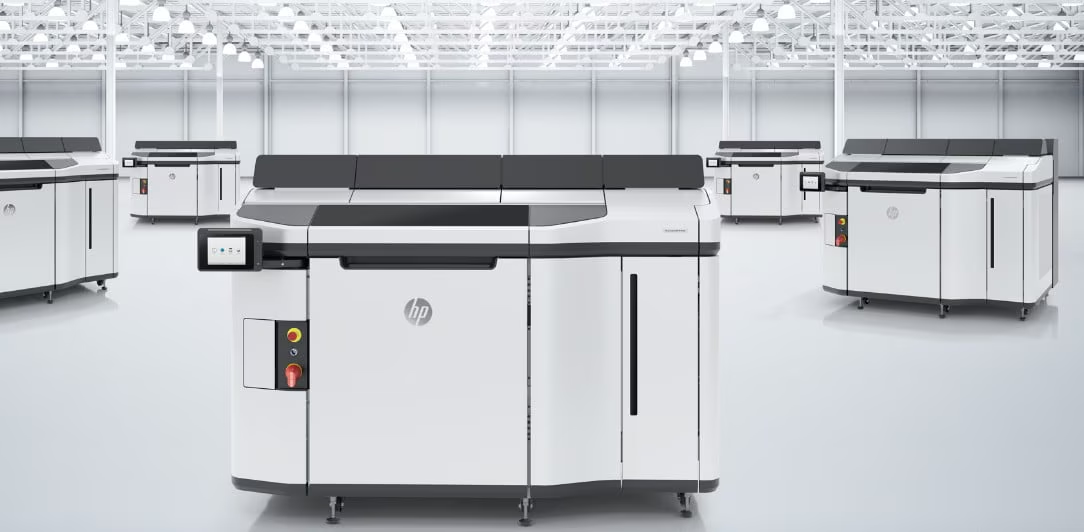
Common materials used in 3D printing include nylon, TPU, ABS, PLA, and advanced engineering polymers. Industrial applications often rely on powder based technologies such as HP MJF 3D Printing Services for strong and functional parts.
Advantages of 3D Printing
Customization is one of the biggest advantages of 3D printing. Each part can be modified without additional tooling costs, making it ideal for low volume production and custom components.
Speed and flexibility are also key benefits. Designs can move from concept to production in days, enabling rapid prototyping and faster product iteration. This is why 3D Printing Services are widely used for Design and Application development across industries.
3D printing is commonly used in 3D Printing Automotive applications, Medical 3D Printing, 3D Printing Drone components, and 3D Printing Aerospace & Defense projects where precision and lightweight structures matter.
Understanding Injection Moulding
What is Injection Moulding
Injection moulding is a manufacturing process where molten plastic is injected into a mould cavity under high pressure. Once cooled, the mould opens and produces a finished part with consistent dimensions.
The process requires an injection moulding machine and precision tooling. While tooling setup requires a higher initial investment, it enables fast and repeatable production at scale.
Common materials used in injection moulding include polypropylene, ABS, polycarbonate, nylon, and other thermoplastics designed for strength and durability.
Advantages of Injection Moulding
Injection moulding delivers high production rates with excellent consistency. Once the mould is created, thousands or millions of identical parts can be produced with minimal variation.
Cost effectiveness improves significantly for large runs. The per part cost decreases as production volume increases, making Injection Moulding the preferred method for mass production and long term manufacturing programs.
Comparison: 3D Printing vs Injection Moulding
Cost Analysis
When comparing 3d printing vs injection moulding cost, several factors influence pricing. These include material choice, production volume, tooling requirements, and post processing.
3D printing has lower upfront costs since no moulds are required. It is ideal for small batch production and early stage products. This makes Small business Injection moulding vs 3D Printing a common decision point for startups and growing manufacturers.
Injection moulding has higher initial tooling costs due to mould fabrication and injection moulding machine setup. However, for large volumes, the cost per part becomes significantly lower. The Economics of Injection Moulding vs. 3D Printing strongly favor injection moulding for mass production.
Production Speed and Scalability
3D printing offers faster setup times since production begins directly from a digital file. It excels in low volume manufacturing and design validation phases.
Injection moulding requires more preparation time due to tooling, but once production begins, it delivers unmatched speed and scalability. Thousands of parts can be produced per day with consistent quality.
Quality and Durability of Products
3d printing vs injection moulding strength depends on the technology and material used. Industrial 3D printing technologies such as HP MJF deliver excellent structural integrity and isotropic strength suitable for functional end use parts.
Injection moulded parts generally offer superior surface finish and long term durability. Moulded components are often stronger for high stress applications and offer tighter tolerances with smooth surfaces.
Post processing also plays a role in both methods, affecting final appearance, strength, and dimensional accuracy.
Use Cases and Industry Applications
When to Use 3D Printing
3D printing is ideal for prototyping where rapid design iteration is needed. Engineers can test multiple versions without additional tooling costs.
Customization needs also favor 3D printing. Industries such as Medical 3D Printing and 3D Printing Aerospace & Defense benefit from tailored designs and lightweight structures. CNC Machining Services are often combined with 3D printing for hybrid manufacturing workflows.
When to Use Injection Moulding
Injection moulding is best suited for large scale production where consistency and repeatability are critical. Consumer products, automotive components, and industrial housings commonly rely on this method.
Applications requiring long term durability and high production volumes benefit from injection moulding due to lower per unit cost and proven reliability.
Conclusion
Choosing between 3D printing vs injection moulding depends on production volume, cost targets, material requirements, and time to market. 3D printing offers flexibility, faster development, and customization, while injection moulding excels in high volume production, surface finish, and long term cost efficiency.
A simple decision matrix helps guide the choice. Use 3D printing for low volume production, rapid prototyping, and complex designs. Choose injection moulding when scaling production and maintaining consistency becomes the priority.
At Amuse3D, we help businesses evaluate the right manufacturing approach using advanced 3D Printing Services, HP MJF 3D Printing Services, Injection Moulding, and CNC Machining Services under one roof. Our team supports everything from Design and Application development to full scale production.
If you are deciding between 3D printing and injection moulding for your next project, contact us today to discuss your requirements or get instant quote directly from our website.

.png)