CNC Machining Cost: The Design Decisions That Raise Your Quote or Bring It Down
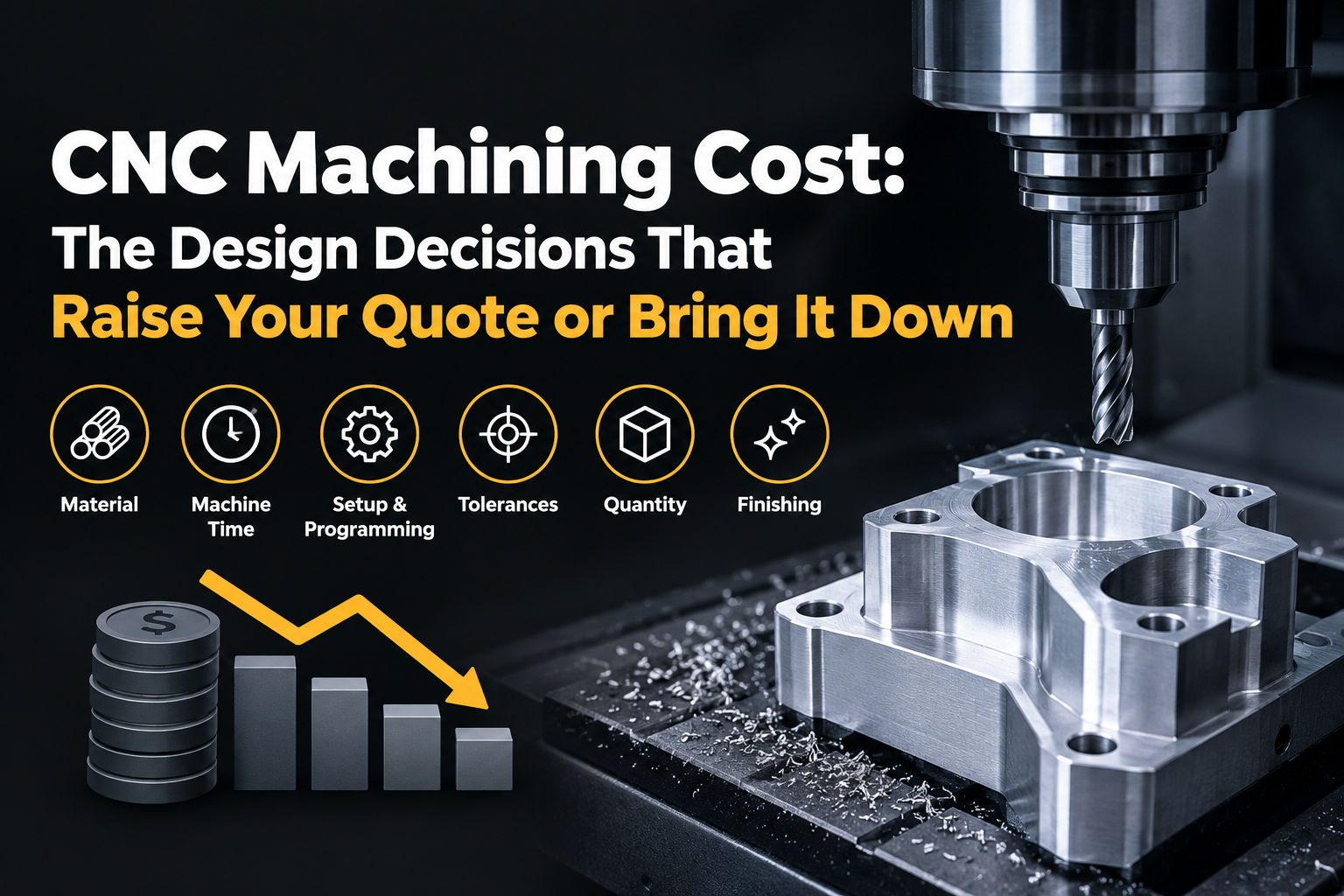
Machined parts are priced on six variables: material, machine time, setup and programming, tolerances, quantity, and finishing. A bracket in aluminium 6061 with loose tolerances can cost a fraction of the same bracket in stainless steel with tight call-outs on the same machine.
This guide covers machined parts and manufacturing, not buying a small desktop CNC machine.
How Much Does CNC Machining Cost?
The cost of CNC machining depends on six variables, not a flat rate. Material cost sets the floor, and machine time on the CNC machine, driven by part geometry, is the largest line item. That holds for CNC machining cost in 2026 as much as ever.
Setup and programming (CAM programming and machine setup, fixturing, tool selection) are fixed costs spread across every part you order. Tolerances and finish add more wherever specified.
For a prototype, setup dominates. For a production run, machine time and material dominate, so the CNC machining price can swing widely for the same part.
What Drives CNC Machining Cost
Ranked by typical impact, the main cost drivers are:
An idle CNC machine earns nothing, so shops charge for every minute it cuts. Run time usually costs more per minute than raw stock does per gram, so a long toolpath could cost more than a pricier material on a quick cycle.
How much CNC equipment time a feature burns decides its price. Geometry and material determine machining time: deep pockets, tiny radii, and thin walls all add minutes. Larger parts need bigger machines, and bigger machines carry higher rates.
The cost varies depending on the machine type: CNC milling, CNC turning, and multi-axis machining centers all carry different rates. Operator and overhead sit behind every hourly figure.
The geometry, not just the material in CNC machining, decides the final cost. Stacking finishes a part doesn't need pushes up total CNC machining spend:
Material Choice and Cost
Material and machining time together change the price twice: raw stock and cutting time. Different types of CNC machines typically run aluminium fast and slow down for stainless, and each tool change stops the machine.
Read more about each material: aluminium 6061, aluminium 7075, SS 304, POM, and nylon
Steel or titanium CNC work increases the cost significantly, and precision machining in these metals raises the overall cost further because of slower speeds and longer machining times.
Tolerances and Surface Finish
Tight tolerances and fine surface finishes demand slower cutting and more inspection effort. A standard class such as ISO 2768 medium is within reach of most 3-axis CNC machines.
By some engineering estimates, a tighter dimension would cost more than double for that feature. The CNC machine runs slower, tools wear faster, and CMM checks replace a caliper spot-check.
Reserve tight tolerances for bearing seats or sealing faces. An over-specified drawing is a common reason a quote comes back higher than expected.
3-Axis vs 5-Axis Cost
A 5-axis machining center carries a higher machine rate, often 100 to 150 per hour or more in published shop-rate guides, versus a lower hourly rate on a basic CNC machine.
A 3-axis job often needs re-fixturing three or more times, and each setup adds non-cutting time and labor. A 5-axis machine can finish the same geometry in one or two setups. That can reduce cost despite steeper machining hourly rates, because the per-part cost falls when setups disappear.
Simple, flat parts stay cheaper on 3-axis equipment. Complex geometry favors 5-axis once you count the setups it removes.
Cost Per Part at 1, 100 and 1,000 Units
Setup cost is fixed per job, so costs are amortized across however many units you order. The setup cost per unit shrinks as quantity grows, since each setup ties up a CNC machine without cutting.
At 1 unit, typical for rapid prototype CNC machining, setup dominates the price per part. At 100 units, cutting time and material dominate. At 1,000 units, the unit cost drops sharply, and the total cost of the run and the project cost level off.
Price at your real quantity, not at a generic CNC machining cost per hour.
How to Reduce CNC Machining Cost
Design decisions made before a file reaches a machine shop deliver the biggest cost reduction. Each change below improves machining efficiency and adds cost savings.
- Fewer setups. They reduce machining time, and each extra one can add to the cost.
- No deep, narrow pockets. Long, thin tools at reduced speeds stretch the machining process.
- Standard hole sizes. Odd diameters force a tool change on the CNC machine and cost more per hole.
- Relax non-functional tolerances. Often the fastest way to reduce CNC machining costs.
- Early design review. A DFM pass catches expensive features before they are locked in.
CNC vs 3D Printing Cost
At very low quantities, 3D printing typically costs less: no setup or tooling, just material and printer time. As quantity climbs, machining overtakes 3D printing vs CNC on economics. That crossover commonly lands between roughly 50 and 100 units, moving higher for lattice geometry.
Machining wins outright for engineering-grade material at full strength, such as aluminium 7075 or SS 304. 3D printing stays the better choice for early concepts and one-off parts.
How to Get an Accurate CNC Quote
A reliable CNC machining quote needs five things up front: a native CAD file (not a PDF), material, quantity, tolerances marked on the drawing, and finish. Miss one and the shop has to guess once CNC operations start, and the CNC machine runs on that guess.
At Amuse 3D, every quote comes with free DFM feedback at no DFM cost, catching a tolerance or pocket depth that would inflate the price before manufacturing starts. Runs from 1 to 1,000 units ship with an inspection report: 3 to 7 days domestically, 3 to 10 days internationally, depending on machine availability.
Conclusion
To reduce your CNC machining costs, simplify the design and ask for a detailed cost breakdown before committing.
Our CNC machines run inside a 50,000 sq ft facility in Oragadam, near Chennai, under ISO 9001:2015 certification. Explore our CNC machining services, and get an instant quote to start your next project.
Frequently Asked Questions
1. What makes one machined part pricier than another?
Material, machine time, setup, tolerances, quantity, and finishing. Only the actual drawing settles it.
2. Is there a CNC cost calculator I can use?
Online tools give a rough order, but CNC pricing is set by the drawing.
3. Is CNC machining India pricing lower than in other regions?
Labor and overhead rates are generally lower than in the US or Europe, though material and tooling are largely global.
4. Do tighter tolerances always raise the price?
Not always, but often. A tolerance tightened on a feature that doesn't affect fit adds inspection and cutting time for no benefit.
5. What should I send for an estimate?
A native CAD file, material, quantity, tolerances on the drawing, and finish.

