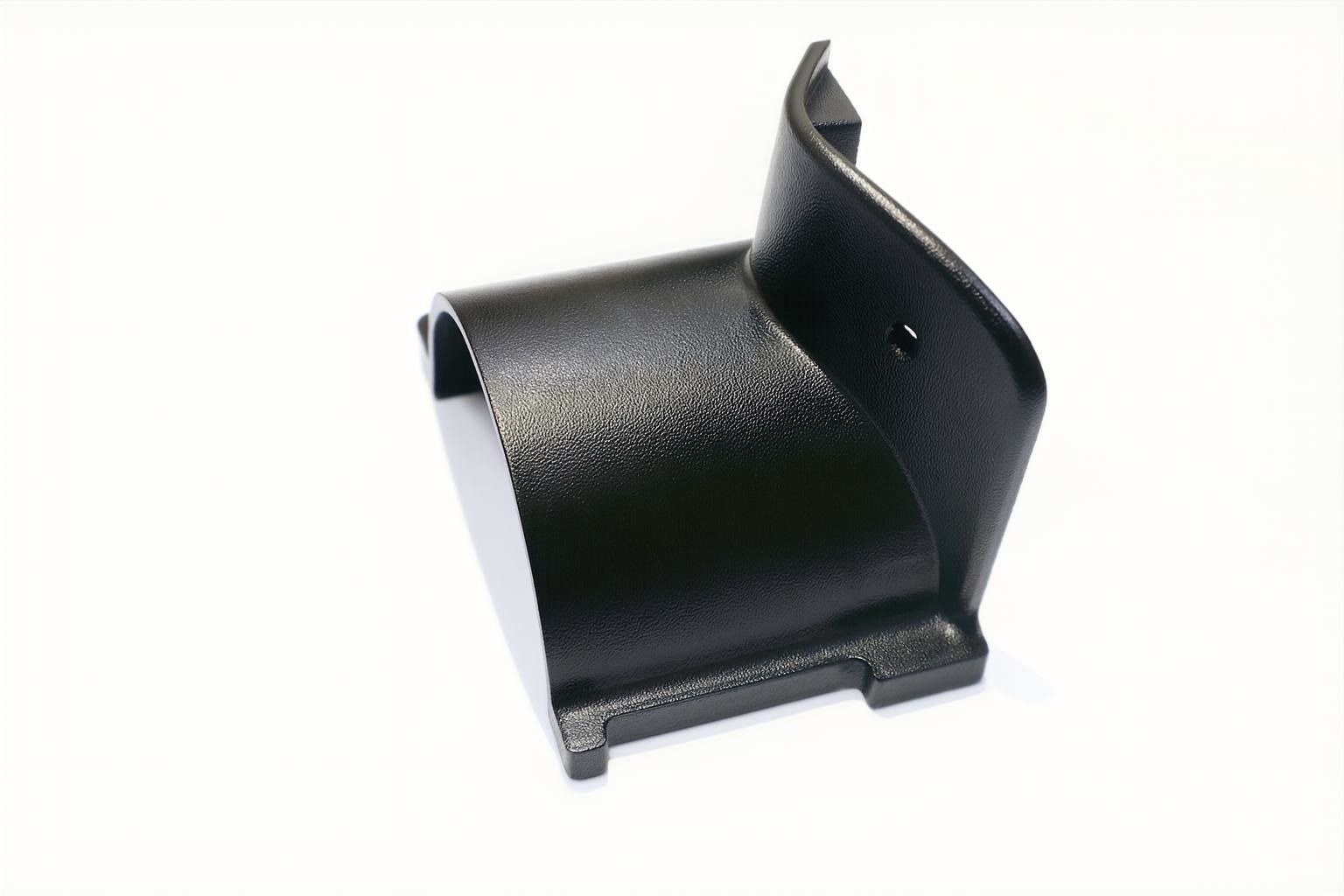
Nylon 3D Printing Guide for Strong Industrial Parts
Talk to any engineer who works with nylon 3D parts daily and it'll come up early. Not because it's fashionable, but because it solves problems other materials can't - a clip that flexes ten thousand times and stays intact, a housing that survives under-bonnet temperatures, a bracket that takes a knock and keeps holding. When you need a part to actually work rather than just pass a visual check, nylon tends to be where the conversation starts.
This guide covers what nylon 3D printing is, how to choose between filament printing, powder sintering and HP Multi Jet Fusion, what makes nylon difficult to work with and how to manage it, and how to pick the right material grade for the application.
What Is Nylon 3D Printing?
Nylon 3D printing is the process of making functional parts from different types of nylon in the polyamide family - most commonly PA12, PA11 or PA6 blends. Three meaningfully different processes fall under that label, and picking the wrong one for a job is the most avoidable mistake you can make with this material.
Nylon is a thermoplastic polymer. The properties of nylon that matter most in engineering use are toughness under impact, abrasion resistance on moving contact surfaces, flexibility under repeated load cycles without fatigue cracking, and chemical resistance against oils and common industrial fluids. It's a combination that's hard to find in a single material, which is why nylon 3D keeps getting specified for jobs that other plastics can't see through.
One thing that tends to catch people out: nylon doesn't tolerate moisture the way PLA or ABS does. Nylon is highly hygroscopic by nature, and that affects every process decision you'll make with it. If you plan to 3D print nylon parts in-house, material storage is as important as machine settings.
PA12 has become the popular material of choice for industrial 3D printing because it balances all of this - strong, stable, low moisture uptake relative to other nylons, and compatible with both SLS and HP Multi Jet Fusion at production scale. Most engineers who want to 3D print with nylon for the first time start with PA12, and most don't need to go further unless the application demands it.
Benefits and Applications of Nylon 3D Printing
Nylon gets specified because it earns it. Here's what actually puts it on the shortlist.
What it's good for
- Functional parts that have to work under load, not just sit in a test rack
- Impact resistance - nylon absorbs knocks rather than cracking through them
- Abrasion resistance on moving parts and contact surfaces, which comes partly from nylon's low coefficient of friction
- Chemical resistance against oils, greases and common industrial fluids
- Good strength-to-weight ratio for compact designs that can't afford added mass
- Snap-fits and flex-dependent assemblies that handle thousands of cycles without fatiguing
Where nylon 3D gets used
Applications of nylon 3D printing cover everything from early prototyping to end-use production. You'll see it in:
- Functional prototyping for fit checks, movement validation and stress testing before tooling is committed
- Jigs and fixtures on assembly lines where parts get used hundreds of times a day
- End-use clips, brackets, covers and housings going directly into finished products
- Bushings, guides and low-load gears where wear resistance determines service life
- Lightweight structures with internal complexity that machining can't reach economically
Industries where nylon 3D printing is used
Nylon 3D printing shows up across all of Amuse3D's core sectors:
- Automotive 3D printing: brackets, clips, cable guides, ducts and interior trim mechanisms
- Medical 3D printing: device housings, functional assemblies and validation prototypes
- 3D printing for drones: frames, mounts and enclosures where vibration resistance and low weight both matter
- Aerospace and defence: lightweight fixtures, ducting and short-run mission-specific components
PA12 is the standard across all four sectors because it delivers consistent properties batch to batch.
Processes and Techniques
There are multiple routes for nylon 3D printing. They're different enough that what works for one job may be wrong for another.
FDM nylon
FDM nylon works by pushing nylon 3D printing filament through a heated nozzle, layer by layer. It's the most accessible option but also the most demanding to run correctly. A nylon 3D printer capable of handling PA12 or PA11 properly needs:
- A hotend that maintains consistently high nozzle temperatures
- A heated build plate, kept at a stable bed temperature throughout the build, with proper first-layer contact to stop parts lifting
- An enclosure to prevent warping as layers cool at high temperatures
- Properly dried filament - material left out in the air will cause problems from the very first layer
- Tuned print speeds to get clean layer bonding
It works well for quick-turn prototyping and one-off fixtures. The trade-off is variability - results depend on orientation, machine condition and how diligently the filament was dried.
SLS nylon
SLS nylon uses selective laser sintering - a laser fuses nylon powder into solid parts layer by layer, with the surrounding unfused powder supporting the build. No support structures needed, which means complex internal geometry, undercuts and nested assemblies are all possible in a single print run.
That makes it the right call when you need consistent mechanical properties across a batch, clean complex geometry without support scarring, and solid repeatability across short to medium production runs.
HP Multi Jet Fusion and nylon 12
HP Multi Jet Fusion uses a different 3D printing process to SLS - fusing and detailing agents are applied across the whole powder bed, then fused in a single heat pass per layer. The result is dense, isotropic parts with strength close to injection-moulded nylon, which is why it's the dominant route for nylon 12 3D printing in industrial production.
When you're evaluating a nylon 3D printing service for PA12 work, ask for actual tolerance specs rather than general claims about accuracy. Per the HP MJF Handbook, the design targets are:
- Minimum gap between mating faces: 0.4mm (±0.2mm per-part tolerance)
- General clearance between assembly faces: at least 0.7mm
- Minimum wall thickness: 0.3mm in XY, 0.5mm in Z
- Dimensional accuracy: ±0.2mm up to 100mm, 0.2% above that
Amuse3D's HP MJF 3D printing services run on 5 HP Jet Fusion 5620 systems with standard lead times of 3-5 days within India and 4-7 days worldwide. Post-print finishing options include dyeing, vapour polishing, shot peening and industrial painting depending on the surface requirement.
Keeping nylon dry
Nylon is hygroscopic - it absorbs moisture from the air, and moisture ruins prints in ways that no settings adjustment can fix. Successful 3D printing with nylon depends entirely on material preparation before the machine is switched on. Every spool needs drying at 70-80°C for at least 8 hours before use. Store it in an airtight container with desiccant between sessions. Skip it once and you'll spend the next few hours wondering why the print looks terrible. The 3D printing experience with nylon changes completely once that habit is locked in.
Wet nylon shows up fast: surface bubbling, stringing, weak layer bonding, dimensional variation and popping sounds during extrusion. For SLS and MJF, material handling is on the bureau's side - one concrete reason to ask about storage practices when choosing a nylon 3D printing service.
Challenges in Nylon 3D Printing
Moisture defects: rough surface, bubbling, popping sounds during extrusion, weak layers. Almost always wet material. Dry it properly and store it sealed.
Warping: nylon is prone to warping as it cools unevenly, and poor bed adhesion means a part can lift off the print bed mid-build. Use a heated bed, a full enclosure and a brim for filament-based prints with vulnerable geometry.
Layer bonding: a printed part that cracks along layer lines under bending is pointing to temperature, print speed or orientation. Tune settings, reorient the part so loads run parallel to layers, or move to a powder-bed process where properties are isotropic by nature.
Surface finish: filament-printed nylon has visible layer lines. Powder-bed parts come out matte and slightly porous. Decide on finishing requirements before the order, not after delivery.
Choosing the Right Nylon Material
Not all nylon grades behave the same. Worth working through these before you commit:
- What type of load will the part carry - bending, impact, sustained weight or wear?
- What temperatures will it see? PA12 has a melting point of 178-180°C - check the grade's heat deflection temperature against the operating environment
- Will it contact oils, cleaners, fuels or moisture?
- How tight are tolerance requirements?
- Does surface appearance matter functionally or cosmetically?
- What production volume are you targeting?
Common grades and where they fit
- PA12 (Nylon 12): the default for SLS and HP MJF. Stable, reliable, dimensionally consistent. Standard grade for Amuse3D's nylon 12 3D printing service
- PA11: bio-based, higher elongation at break than PA12, better suited to living hinges and parts that flex repeatedly without fatiguing
- Glass-filled nylon and PA12 CF: reinforced grades for stiffer applications, often evaluated as metal substitutes
- Nylon 6 (PA6): mostly relevant for injection moulding rather than 3D printing - worth considering once volumes justify tooling
When nylon isn't right: very high rigidity requirements, temperatures well above PA12's operating range, or a smooth cosmetic finish off the machine without post-processing - any of these might point to a different material. The design and application team can help work through the right call for your specific part.
Conclusion
Nylon 3D printing is one of the more reliable options in engineering plastics for parts that have to actually perform. Filament printing for speed and accessibility, powder-bed processes for production-grade consistency. It demands care with moisture management, but get that right and the parts hold up.
At Amuse3D, HP MJF 3D printing services sit alongside injection moulding and CNC machining for when production volumes outgrow what 3D printing handles alone.
Get an instant quote and see pricing and lead time before you commit.
Frequently Asked Questions
1. Why does nylon warp so much compared to PLA or ABS?
Nylon shrinks more as it cools, creating internal stress that pulls parts away from the build plate. PLA has much lower shrinkage and cools more evenly. An enclosure that holds ambient temperature steady, a heated build plate and a brim to increase first-layer contact are the three things that make the biggest difference. Uniform wall thickness in the design helps too, as thin-to-thick transitions are the most warp-prone areas.
2. How long does nylon filament need to dry before printing?
For PA12, the consistent guidance across printer manufacturers and filament suppliers is 70-80°C for at least 8 hours. If you hear popping during extrusion or see a rough surface on the first layer, the filament is already too wet - no settings adjustment will fix it. After drying, store the spool in an airtight container with fresh desiccant and don't leave it on the bench between sessions.
3. Is MJF nylon as strong as injection-moulded nylon?
For PA12, HP Multi Jet Fusion produces parts that sit close to injection-moulded nylon for most practical mechanical properties. MJF parts are also isotropic - strength runs consistently in all directions because the powder-bed process fuses the whole cross-section uniformly, unlike FDM which builds directional layer lines. Where injection moulding still wins is on very high volumes and smoother out-of-tool surface finish.
4. What's the difference between PA12 and PA11 for 3D printing?
PA11 has higher elongation at break, making it better suited to living hinges and snap-fits that cycle thousands of times without cracking. PA12 has lower moisture absorption, giving it better dimensional stability in variable humidity and making it easier to process consistently. If the part needs to flex repeatedly, lean towards PA11. If tolerances matter more than flex, PA12 is usually the safer choice.
5. Can nylon 3D printed parts be used outdoors or in wet environments?
Yes, with the right grade and process. PA12 from SLS or MJF has solid UV and chemical resistance. The hygroscopic behaviour matters during printing and raw material storage, not in the finished cured part. For outdoor structural use, check the part's operating temperature against PA12's heat deflection temperature. Dyeing or vapour polishing can improve surface sealing further where moisture ingress matters.

.png)