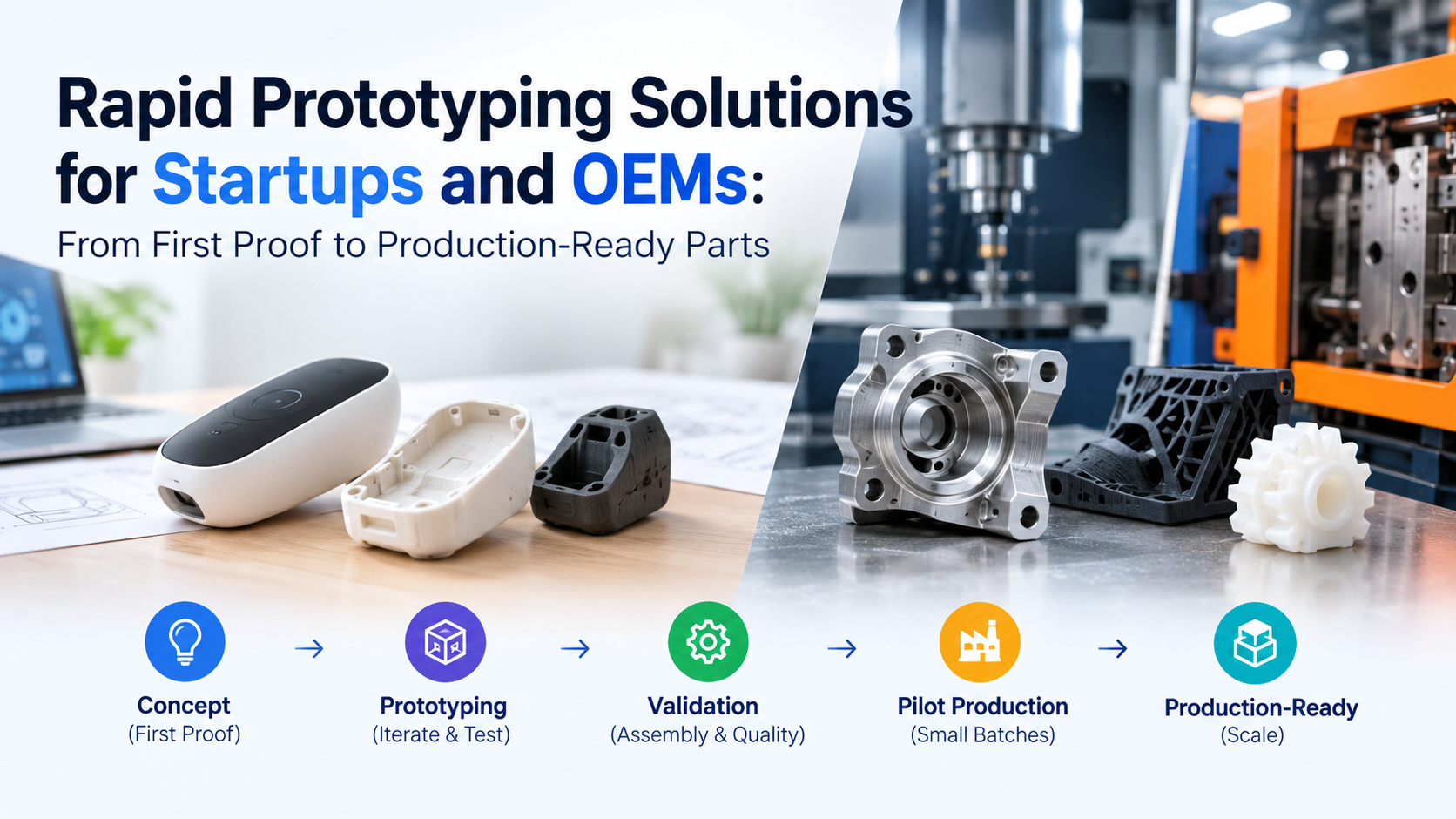
Rapid Prototyping Solutions for Startups and OEMs: From First Proof to Production-Ready Parts
A startup validating a consumer electronics concept and an OEM qualifying a custom part for an existing production line both need rapid prototyping solutions, but different things from them. The startup needs an actual product a user can hold, fast and cheap, ahead of time to market pressure.
The OEM needs a part that survives assembly, passes inspection, and repeats at volume. This guide compares rapid prototyping services and prototype development solutions, from stereolithography through CNC machining and rapid tooling, to the stage each answers.
What Are Rapid Prototyping Solutions?
Rapid prototyping solutions are not a single machine or material. They combine process selection, material selection, and a design iteration loop that turns a digital 3D CAD file into a tested part fast enough to inform the next decision product developers need to make.
Product prototyping solutions mean choosing between additive and subtractive manufacturing, building in a feedback step before committing production costs to tooling, changing as a product design moves from concept sketch to production-ready part.
Why Startups and OEMs Need Different Prototyping Strategies
Startup design teams and OEM rapid prototyping programs solve different problems, and connecting each need to the right process decides the approach:
These are different points on the same development process, and the right technology shifts as a project moves along it.
Rapid Prototyping Solutions for Startups
Early-stage rapid prototype manufacturing compresses traditional methods of iteration into days. Rapid prototyping for startups usually begins with 3D printing rapid prototyping: 3D printing services deliver FDM and SLA parts directly from any 3D printer or CAD file, checking form and fit at the lowest cost per iteration.
As the design firms up, HP MJF printing adds thermoplastic parts with real mechanical properties, useful for a consumer electronics housing or medical devices enclosure that must survive actual handling.
The goal is rigorous testing on an actual, 3D printed product, not a render. Since startups manage production costs closely, custom prototyping services that are cost-efficient and tooling-free let a design cycle run repeatedly without a mold's sunk cost.
Rapid Prototyping Solutions for OEMs
Industrial rapid prototyping for OEMs starts once there is an existing manufacturing stack the new part has to fit into, built on manufacturing techniques and manufacturing technology already proven on the factory floor.
- Repeatability: CNC machining services and powder bed fusion batches, dimensionally consistent across a run.
- Assembly validation: parts in production-representative materials, pressed into a real sub-assembly, the same design for assembly checks used downstream.
- Engineering documentation: first-article inspection data and material certification feeding the OEM's quality system.
- Pilot builds: controlled runs validating the manufacturing project ahead of production readiness.
Aerospace and automotive OEMs lean on industrial rapid prototyping through CNC machining services for engineering-grade metals, where traditional manufacturing methods set the tolerance bar, validated with functional prototypes and functional prototype services that bring better products to market.
Rapid Prototyping Technologies and Where They Fit
The ISO/ASTM 52900 standard groups 3D printing technologies into seven categories; vat photopolymerization (stereolithography, abbreviated SL) and powder bed fusion (selective laser sintering and HP MJF) are the two most relevant to rapid prototyping with 3D printing.
Amuse3D runs HP MJF printing and CNC machining services alongside SLA, FDM, vacuum casting, and sheet metal fabrication, each suited to a different stage:
A SLA vs SLS comparison finds SLA holds tighter tolerances and a smoother surface, while SLS produces tougher, heat-resistant parts. See Amuse3D's 3D printing materials reference for material selection, and post processing options for how a new product will look and perform.
How to Choose the Right Prototyping Process
The product development process determines the right solution at each stage:
- Does the design work at all? SLA or FDM, a direct rapid prototyping 3D route from CAD, lowest cost per iteration.
- Does it function like the real thing? HP MJF or SLS for mechanical properties closer to the final material.
- Will it survive assembly and real-world testing? CNC machining in production-grade metal or plastic.
- Will it repeat at volume? Vacuum casting or rapid tooling for pilot quantities.
Amuse3D's design and application guidance narrows this further for specific tolerance needs.
From CAD File to Tested Prototype
Going directly from CAD to a physical part lets product designers catch design iterations that would otherwise surface later, when a change costs more. Design for additive manufacturing principles shape how a part is built for 3D printing, rather than shrinking a CNC design into a printable file.
Short design cycles make rapid prototyping useful for product development.
How Rapid Prototyping Reduces Product Development Risk
The value of a prototype is in what it rules out. Real-world testing surfaces fit and function problems earlier than a CAD review alone, cutting time from concept to a tooling-ready design.
For a startup, that means minimizing the risk of a flaw a low-cost prototype would have caught. For an OEM, rigorous testing protects a project with a launch date attached.
Moving from Prototype to Pilot Production
Vacuum casting reproduces a master pattern into silicone molds and casts polyurethane parts that mimic production plastics, useful for short runs that still need to look and perform like the final part.
For plastic parts headed toward injection moulding, rapid tooling using an aluminum tool runs faster than hardened steel, since machining aluminum is five to ten times faster:
Amuse3D's prototype to production overview covers the handoff.
When to Move from Prototyping to Injection Moulding
Cost and lead-time considerations, not a fixed part count, decide this. Low volume manufacturing stays economical as long as per-part cost beats cutting a mold.
Once lead time cannot sustain a quantity, injection moulding (injection molding) pays for itself. OEMs with a defined forecast can plan this earlier than startups still validating demand.
How to Choose a Rapid Prototyping Solutions Partner
A rapid prototyping services partner should offer more than a single 3D printing service: in-house additive and subtractive manufacturing, material selection support for designers and engineers, documented quality processes for OEM programs, and a clear path from prototype to pilot tooling to production.
Why Work With Amuse3D for Rapid Prototyping?
- HP MJF 3D printing, injection moulding, and CNC machining in one Chennai facility
- India's largest HP MJF 5620 fleet, five printers
- ISO 9001:2015 and IATF 16949:2016 certified
- Over 3 million parts shipped a year to 1,000+ clients in 30+ countries
- MJF nylon parts rated 4.96/5 by 200+ engineers
- CNC tolerances down to 5 to 10 microns, for single prototypes and OEM pilot programs alike
Conclusion
Startups and OEMs both need rapid prototyping solutions, but a startup chasing speed and an OEM validating repeatability need different processes. Matching SLA, MJF, CNC machining, vacuum casting, and rapid tooling to the right stage, run in-house from one Chennai factory, gives either team a real competitive advantage.
Contact our engineering team to map a part to the right process, or get an instant quote to start.
Frequently Asked Questions
1. What is the difference between a prototype and a pilot build?
A prototype validates a design, often in a different material than final production. A pilot build validates the manufacturing process itself, using production-representative tooling.
2. When should an OEM move from 3D printing to CNC machining for prototypes?
Once a prototype needs testing in production-grade metal or plastic for assembly validation, CNC machining typically takes over.
3. How many units can vacuum casting produce before injection moulding makes more sense?
Silicone molds have a limited lifespan, so once a project needs a quantity beyond what a few can supply, rapid or production tooling becomes more economical.

