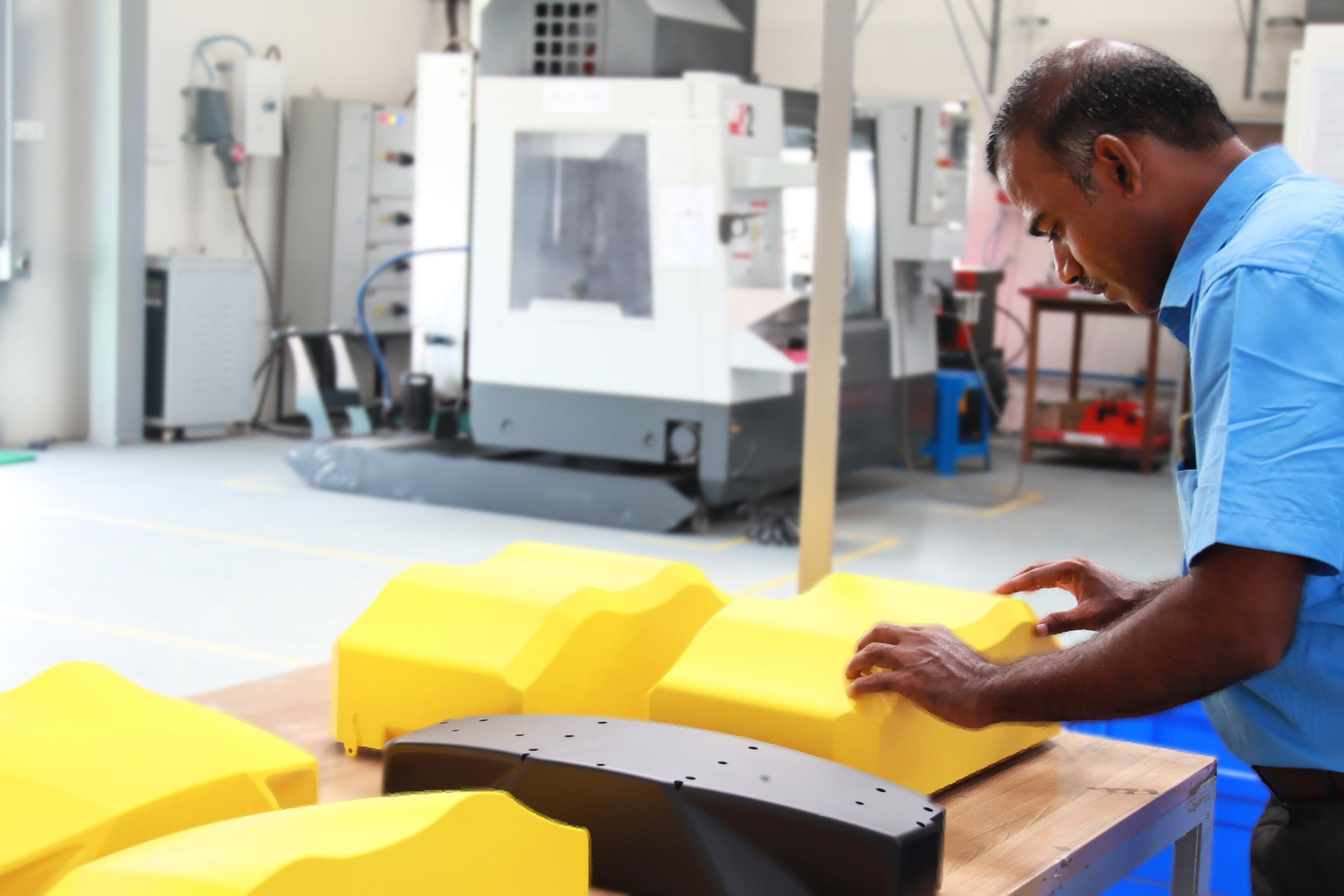
What Is Rapid Prototype CNC Machining and When Should You Use It?
In the fast-paced arena of product development, getting an idea from scratch to a tangible prototype as quickly as possible is the difference between leading the market and watching competitors steal your business.
Rapid prototype cnc machining is a critical process in modern manufacturing, serving as the bridge between design and production. Learning how to use CNC rapid machining is absolutely key, whether you are building a new drone component or even designing a medical device.
What Is Rapid Prototype CNC Machining?
To grasp this process, we need to examine two different concepts:
- Rapid Prototyping —Fast manufacture of a physical part or assembly using CAD data. It enables engineers to test form, fit, and function before incurring the cost of costly tooling.
- CNC Machining – Computer Numerical Control (CNC) is a subtractive manufacturing technique. A machine that removes material from a solid block (billet) to make a final part with high-speed cutting tools.
Together, these two technologies form rapid-prototype CNC machining: a high-precision method for producing functional, end-use-quality prototypes in days rather than weeks. Unlike traditional machining, rapid CNC is about getting the job done quickly and more fluidly, skipping the painstaking setups that come with mass production.
How Rapid Prototype CNC Machining Works
It all starts with a 3D digital model. This file is then converted into G-code, the language the CNC machine speaks. Then the machine moves through those coordinates to mill the part from an aluminum or plastic block.
It is "subtractive," the opposite of 3D printing. The integrity of the material is preserved in rapid CNC machining because it doesn't melt or layer. It simply shapes. That creates components with structural characteristics equal to those of the end product.
When Rapid Prototype CNC Machining Makes the Most Sense
As great as 3D Printing Services are for visual models in the development stage, rapid CNC prototyping has an advantage under the following scenarios:
- Strength is Mandatory — If your part has to endure high stress or heat.
- Location Specificity —The material from which you need the part must be the precise production material (Aluminum 6061, Stainless Steel, etc)
- Surface Finish —You need tight tolerances or a shiny surface that cannot be built with layers.
- Functional Testing — You are conducting mechanical tests in which the part must act as a molded or cast part.
Rapid Prototype CNC Machining vs 3D printing
The choice between 3D printing, injection moulding, or CNC machining usually comes down to your stage of development.
- 3D Printing (additive) — Ideal for complicated shapes and super-speed iterations. In hubs such as 3D printing Chennai, it is used by designers for quick "feel" tests.
- CNC Machining (Subtractive) —Best for structural integrity. HP MJF 3D Printing Services provides excellent functional plastic short runs. However, CNC still gets the crown in this area for metal prototypes.
- Injection Moulding —This is used for large quantity production. CNC prototyping is the "validation" step for your designs before incurring the steep expenditure on Injection Moulding dies.
Common Materials Used in CNC Prototype Machining
The variety of materials is one of the biggest advantages of rapid CNC. You are not limited to "printable" resins or filaments.
- Metals — Aluminum, Stainless Steel, Brass, and Titanium
- Plastics — Abs, Peek, Polycarbonate, and Nylon
These materials are crucial for 3D Printing Automotive and 3D Printing Aerospace & Defense applications, where there is no such thing as "good enough"—the materials must meet safety standards.
Key Benefits of Rapid Prototype CNC Machining
- Precision — Tolerance as tight as +/- 0.05mm can be given through rapid prototype CNC machining.
- No tooling cost — Unlike molding, nothing expensive to create molds.
- Speed — Fastest modern CNC prototyping shops can deliver parts in 3 to 5 days.
- Versatile — Perfect for everything from Medical 3D Printing surgical guides to high-strength 3D Printing Drone frames.
How to Choose the Right CNC Prototype Machining Partner
When searching for CNC Machining Services, find a partner who understands Design and Application. Your CNC fabrication company will have to leverage their knowledge and experience with DFM (Design for Manufacturability) improvements to your CAD file to lower prices or increase rapid CNC machining speed.
Conclusion
For engineers who never want to sacrifice quality or performance, Rapid-prototyping CNC machining is the ultimate tool. It serves as a bridge from design to production, helping ensure your product is tested, proven, and ready for the real world.
At Amuse3D, high-performance manufacturing is our specialty. Though we stand out as a leader in 3D printing in Chennai, our real strength lies in our professional CNC Machining Services. Whether it's 3D Printing Aerospace & Defense or a custom part for a medical trial, our team is here with the precision and speed your project needs. Whether it is a 3D-printed automotive part or an industrial component, we bring your idea to life.
Eager to take your idea off paper and make it a reality? Talk to our engineering experts today or simply start your manufacturing journey with Amuse3D.
FAQs
- Is CNC machining more expensive than 3D printing for prototypes?
Usually, yes. There is material waste and machine setup time associated with CNC. But when it comes to structural parts that need strength, the utility of a CNC outweighs the expense.
- What is the typical lead time for rapid CNC?
Generally, rapid CNC prototyping can take from 3 to 7 working days, depending on part complexity and finishing requirements.

.png)